
When to add weight: the rep range rule
Give each lift a rep range, such as 8 to 10. Keep the weight the same until your client reaches the top of the range on every set, then add the smallest jump the lift allows and start again at the bottom.
Trainers call this double progression: first the reps go up, then the weight.
Start at a weight where 8 reps are hard: the last one slow, with one or two left in the tank. A weight the client could lift 13 times never reaches the jump.
The rule, week by week
Say the program has bench press at 3 sets of 8 to 10, and your client starts at 135 lb.
- Week 1: 8, 8, 8 at 135 lb
- Week 2: 9, 9, 8 at 135 lb
- Week 3: 10, 10, 10 at 135 lb
- Week 4: 140 lb, back to 8, 8, 8
Every set at 10 is the signal. Two sets at 10 and one at 9 is not there yet, so the weight stays.
Weeks 2 and 3 are progress too. The weight didn't move, but the client did more work with it. Clients tend to miss that, so say it.
Count only reps done with the form you coached and the rest the program sets. A tenth rep that turns into a different exercise doesn't count toward the jump.
The rule to copy
Rep range rule

Example: bench press, 3 x 8-10
- Keep the same weight until every set reaches 10.
- Then add the smallest jump the lift allows (5 lb or 2.5 kg on most barbell lifts).
- Start again at 8 and work back up to 10.
- If the first set at the new weight comes in under 8, go back to the old weight for another week.
Paste it into the notes of any lift and change the numbers. The same wording works for 6 to 8 on a heavy squat or 12 to 15 on a lateral raise.
How much to add
The American College of Sports Medicine's position stand on resistance training gives a number. When someone can do the current weight for one to two reps over the target, it recommends raising the load by 2 to 10% (2009). Our reading: if 8, the bottom of an 8 to 10 range, is the target, then 10 on every set is two reps over it, the same signal as the rule above.
On a barbell lift, 5 lb is usually inside that band. Going from 135 to 140 lb on a bench press is about a 4% jump. Going from 225 to 230 lb on a squat is about 2%.
Small lifts are the exception. If dumbbells in your gym go up in 5 lb steps, moving a lateral raise from 15 to 20 lb is a 33% jump, more than three times the top of that band.
For lifts like that, use a wider range so the reps can carry the progress. A lateral raise at 12 to 20, or a curl at 10 to 15, gives the client room to build into the next dumbbell before they pick it up.
When reps stall or drop
A drop right after a jump is expected. Going from 10s at 135 to 8s at 140 is the rule working.
If the first set at the new weight comes in under the bottom of the range, say 6 at 140, the jump was too big for that lift right now. Go back to 135 for another week, or use a smaller jump if your gym has fractional plates. One later set dropping a rep, say 8, 8, 7, is normal: keep the new weight and build from there.
If the reps sit still for three weeks or more, look outside the program before changing it. Missed sessions or a rough week of sleep can look like a stuck lift, and a weekly check-in will show you which it is.
If the week-to-week picture looks fine and the lift is still stuck, change one thing: a new rep range (6 to 8 instead of 8 to 10) or a close variation of the lift for a few weeks.
When to use something else
- A new client often climbs through the range in a week or two. Let them. The rule still holds; it just moves faster at the start.
- Heavy work in the 1 to 5 rep range is often planned with percentages of a max or with how many reps the client has left in the tank. A narrow range like 3 to 5 still works if you want one rule across the program.
How to explain it to a client
Clients judge a workout by the weight on the bar. Tell them the rule once, in plain words, before the first week:
- "We keep this weight until you get 10 on every set, then it goes up and you start at 8 again. A week of 9s is a good week."
- "If it drops to 8 when the weight goes up, that's the plan, not a bad day."
The rule works best when the client knows last week's numbers when they pick up the bar. Write them down, or have them logged where the client can see them during the set.
How SyncSet handles it
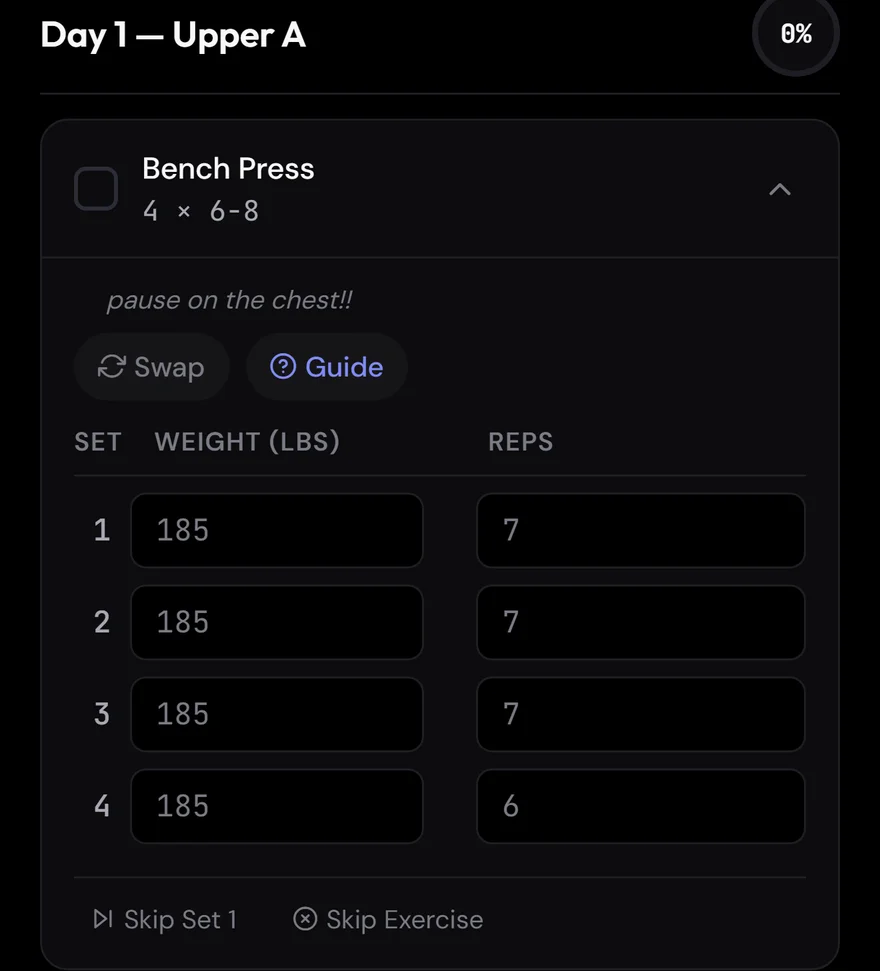
Write the range in the program as you normally would, for example 3x8-10, and your client sees it under the exercise name. While they log, every set shows what that same set did last time, weight and reps, in grey. So the client knows what to beat before they lift, and a set that matches last time takes one tap to log.
Questions trainers ask
What is double progression?
A way to progress a lift in two steps: first add reps within a set range, then add weight once every set reaches the top of the range, and start again at the bottom.
How do I know when a client should increase weight?
When they reach the top of the rep range on every set with good form. With 3 sets of 8 to 10, that means 10, 10 and 10 at the same weight.
How much weight should a client add?
The smallest jump the lift allows. The American College of Sports Medicine suggests 2 to 10% once the client can do one to two reps more than the target. On most barbell lifts that is 5 lb or 2.5 kg.
Is adding reps progress, or only adding weight?
Both count. In an 8-week study of leg training in 43 people with at least a year of lower-body training, one group added weight and kept the reps the same, and the other added reps and kept the weight the same. Gains in muscle size and strength were close between the groups, and the authors concluded that both are workable ways to progress.
Does a client have to keep adding weight?
To keep getting stronger, yes. The 2026 update to the American College of Sports Medicine's position stand concludes that healthy adults should do progressive resistance training. It also notes that training helps even without progression, so a client who only wants to maintain can hold steady. Adding reps first, as in the rule above, counts as progression.
Sources
All read on 2026-11-11.
- American College of Sports Medicine (2009). Progression models in resistance training for healthy adults. Medicine and Science in Sports and Exercise, 41(3), 687 to 708. doi.org/10.1249/MSS.0b013e3181915670
- Plotkin D, Coleman M, Van Every D, Maldonado J, Oberlin D, Israetel M, Feather J, Alto A, Vigotsky AD, Schoenfeld BJ (2022). Progressive overload without progressing load? The effects of load or repetition progression on muscular adaptations. PeerJ, 10, e14142. doi.org/10.7717/peerj.14142
- Currier BS, D'Souza AC, Singh MAF, and colleagues (2026). American College of Sports Medicine position stand. Resistance training prescription for muscle function, hypertrophy, and physical performance in healthy adults: an overview of reviews. Medicine and Science in Sports and Exercise, 58(4), 851 to 872. doi.org/10.1249/MSS.0000000000003897
Keep going
-
 A 4-day upper/lower split for an intermediate client, with the research behind each choice
Read it, 7 minutes
-
 Weekly check-ins that tell you something
Read it, 5 minutes
Paste a workout. Watch it transform.
Try it with one of your own programs. No account needed.