
Weekly check-ins that tell you something
Most of your clients' training happens when you are not there. A short weekly check-in tells you how those days went, and gives you something specific to reply to.
Below: what the research supports, a question set you can copy into whatever form you use, how to read the answers, and how to reply.
What the research supports
A 2016 review pooled 138 experiments with 19,951 people. In each, one group was helped to keep track of their progress toward a goal and the other was not. Keeping track made people more likely to reach the goal, and the effect was larger when people reported their progress to someone else and when they wrote it down (Harkin and colleagues, Psychological Bulletin).
An earlier review of 122 programs aimed at getting adults to exercise more and eat better pointed the same way. Of 26 techniques, self-monitoring explained the most difference between programs, and programs that paired it with a related technique such as goal setting or feedback did better than the rest (Michie and colleagues, Health Psychology, 2009).
Be precise about what that covers. The research is about tracking progress toward the goal itself: sessions done, and whatever the goal is measured by, such as bodyweight, a lift or a measurement. So that is the core of a check-in. Ratings of sleep, stress and energy are context for reading those numbers, and nothing in these reviews tests them on their own.
A question set to copy
Weekly check-in

1. How many of your planned sessions did you get in this week?
2. Your goal number this week (for example bodyweight, a lift, or a measurement):
3. Energy, 1 to 5 (5 = great)
4. Soreness, 1 to 5 (5 = very sore)
5. Sleep, 1 to 5 (5 = slept great)
6. Stress, 1 to 5 (5 = very stressed)
7. Motivation, 1 to 5 (5 = can't wait to train)
8. Any pain? Where, and what does it feel like? (Describe it. Don't rate it.)
9. Anything I should know about this week or next?
Say on the form which end of each scale is good, because on soreness and stress a 5 is bad and on the rest it is good. Clients mix them up otherwise.
Keep pain separate from soreness. Soreness is a number you watch; pain the client describes in words, so you can decide whether it needs a change to the program or a referral.
If your clients log their workouts, you can drop question 1, because the log already answers it. If they do not, it matters more than any of the ratings.
How to read the answers
Compare each week with the last few, not with an ideal. A drop that lasts two or three weeks is worth asking about. A single low week often has its explanation in question 9.
Some patterns worth a question:
- Sessions done falling while motivation holds: ask what got in the way. A change in schedule is a common answer.
- Soreness high week after week: look at how much work the program asks for.
- Poor sleep and high stress together: check whether the hard sets that week still make sense.
- The goal number stuck for several weeks with sessions done: that points at the program more than at the client.
How to reply
The research found the bigger effect when progress was reported to someone. Our own view, not a finding, is that a check-in nobody answers stops getting filled in. A reply can be two lines, as long as it shows you read it:
- "Four out of four and your squat moved up again. Sleep looked rough, so keep Thursday as written but stop each set a rep earlier if you're wiped."
- "Two sessions this week, and you mentioned the new shift. Want to switch to three shorter days for a couple of weeks?"
- "Thanks for flagging the knee. Skip lunges this week and send me a quick video of your squat on Monday."
When a client stops sending check-ins, reply to the silence the same way: a short, specific message, not a reminder of the rules. "Haven't seen a check-in in two weeks, everything okay?" is easy to answer.
Online clients need this more than in-person ones, since the check-in is most of what you see of their week. With in-person clients you can keep it shorter and ask the rest at the start of the session.
How SyncSet handles it
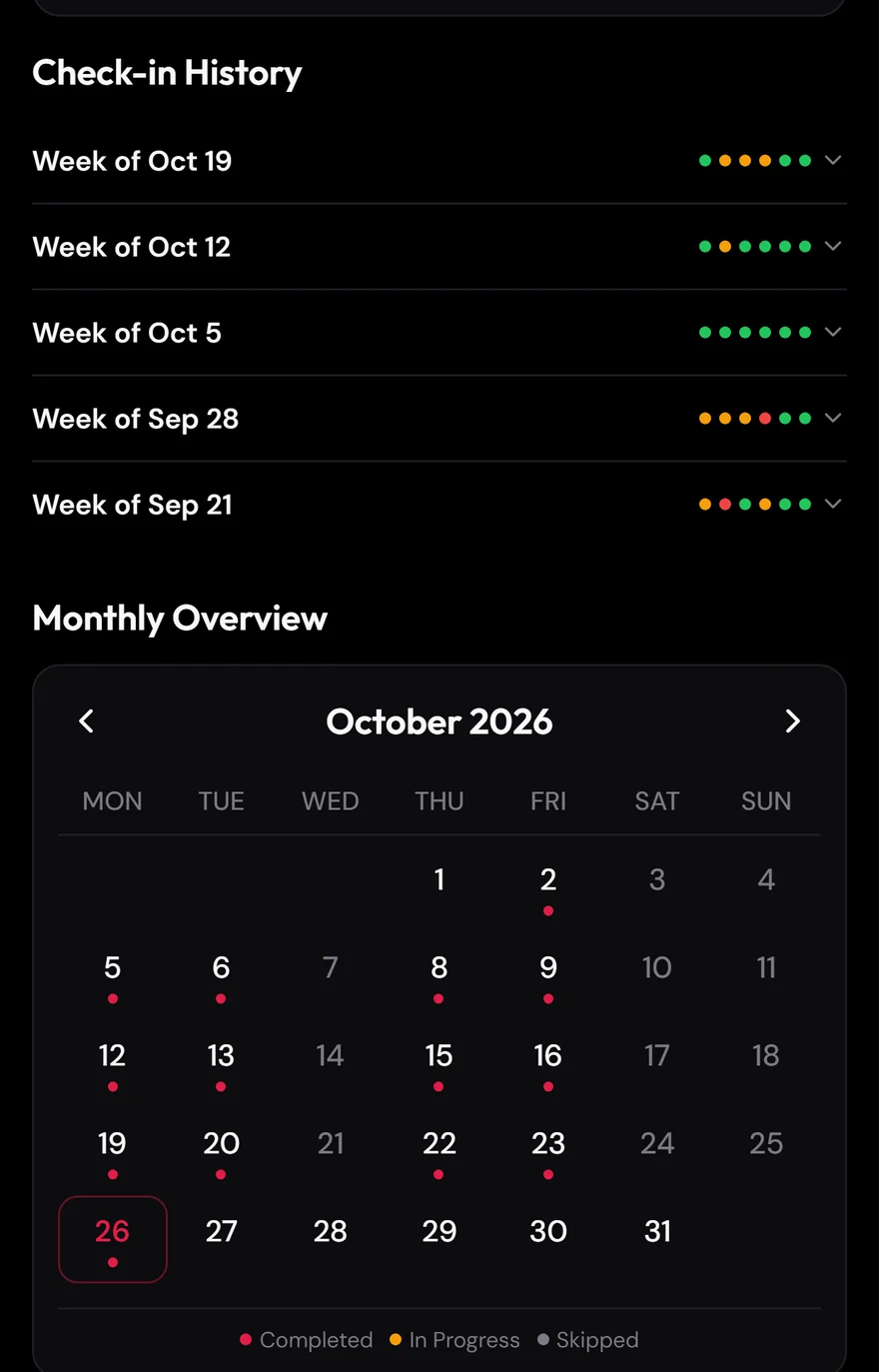
Your client logs their workouts, so the sessions they did and skipped are recorded without asking. On their check-in day, the check-in appears at the top of their training screen: energy, soreness, sleep, stress and motivation, each a tap on a labelled scale, and a box for notes. On your side, each client's page keeps their check-ins week by week above the calendar of the sessions they completed.
Sources
All read on 2026-11-06.
- Harkin B, Webb TL, Chang BP, Prestwich A, Conner M, Kellar I, Benn Y, Sheeran P (2016). Does monitoring goal progress promote goal attainment? A meta-analysis of the experimental evidence. Psychological Bulletin, 142(2), 198 to 229. doi.org/10.1037/bul0000025
- Michie S, Abraham C, Whittington C, McAteer J, Gupta S (2009). Effective techniques in healthy eating and physical activity interventions: a meta-regression. Health Psychology, 28(6), 690 to 701. doi.org/10.1037/a0016136
Keep going
-
 How to write coaching cues your clients follow when you are not there
Read it, 4 minutes
-
 A 4-day upper/lower split for an intermediate client, with the research behind each choice
Read it, 7 minutes
Paste a workout. Watch it transform.
Try it with one of your own programs. No account needed.