How to write coaching cues your clients follow when you are not there
A cue that fixes a rep when you are standing next to your client often does nothing when they train alone, because all they have is the line you wrote, read between sets with their heart rate up.
Here is what helps that line do its job.
1. Point at the result
"Push the floor away" is easier to feel than "squeeze your quads." The first tells your client what should happen. The second asks them to find a muscle and switch it on halfway through a rep.
Researchers call the first kind an external focus and the second an internal focus. A 2021 review pooled 73 studies with 1,824 people on how well they moved in the moment, and 40 studies with 1,274 people on how much they kept when tested again later. The external focus came out ahead on both, and by more on what people kept (Chua and colleagues, Psychological Bulletin). The studies cover many kinds of movement, not barbell lifts in particular, so take it as a strong pointer for the gym rather than proof for the squat.

Some of the usual cues, said the way a client can feel them:
- "Knees out" means push the floor apart.
- "Chest up" means show the logo on your shirt.
- "Brace your core" means tense up like someone is about to punch your stomach.
- "Hinge at the hips" means push your hips back to the wall behind you.
- "Squeeze your back" on a row means pull your elbows to your back pockets.
When a muscle cue is the right one
For a client chasing a bigger muscle on a small lift, the muscle cue can win. In an 8-week study, 30 untrained men followed the same program. Half were told to focus on contracting the target muscle and half on the outcome of the lift. The muscle-focus group's elbow flexors grew 12.4% against 6.9%, while their quadriceps grew about the same in both groups (Schoenfeld and colleagues, European Journal of Sport Science, 2018). That is one small study, so "squeeze the biceps at the top" is a fair cue on a curl, and the larger body of research above still favours pointing at the result on the big lifts.
2. One short line per lift
Between sets your client glances at the screen for a few seconds. Write the one thing that matters most for that client on that lift, and keep everything else for when you see them.
If a client keeps making the same mistake, that cue stays. Once they have it, swap in the next one.
3. Put the cue on the exercise
Your client is far more likely to read a cue where they are already looking during the workout than in a text thread from last Tuesday.
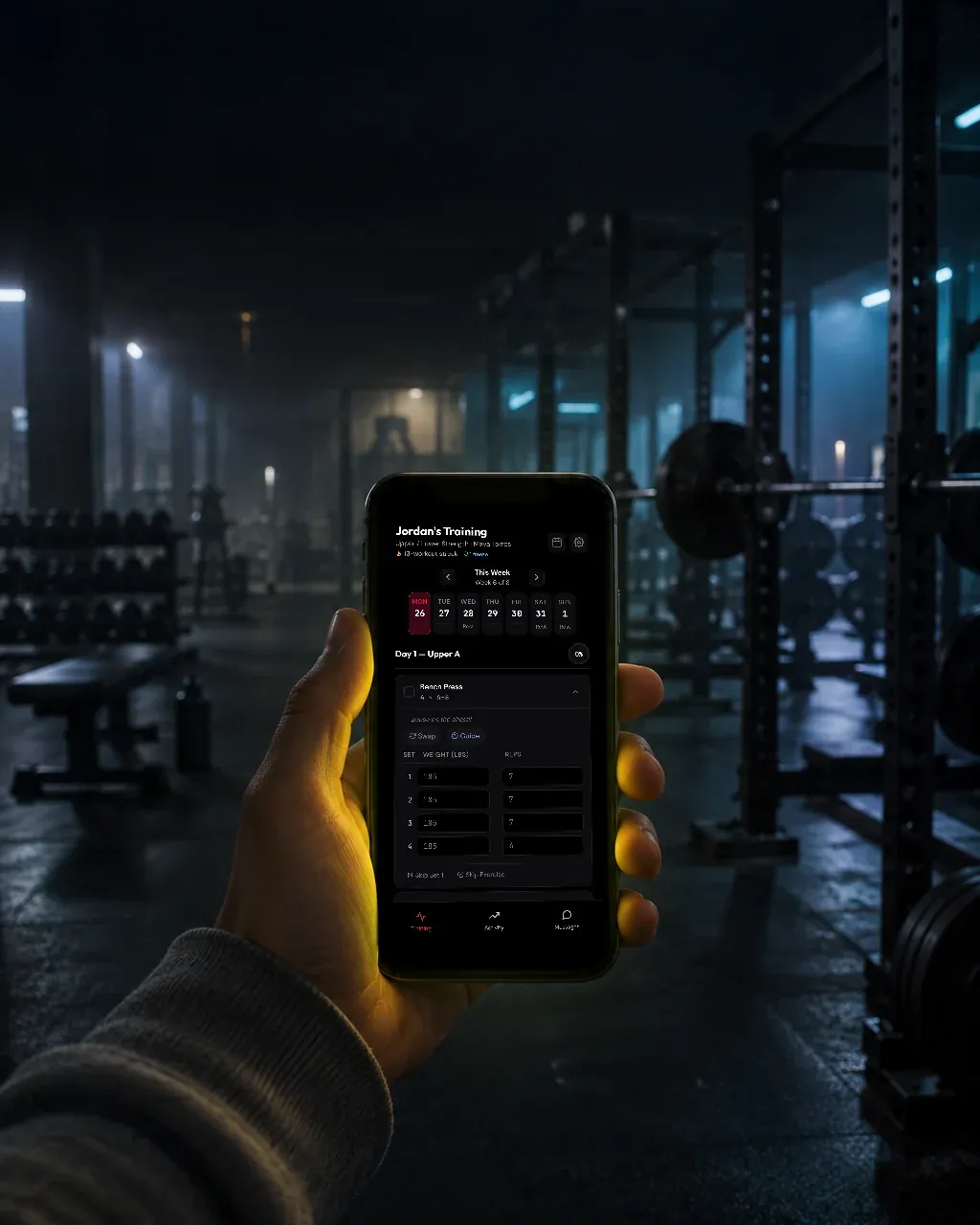
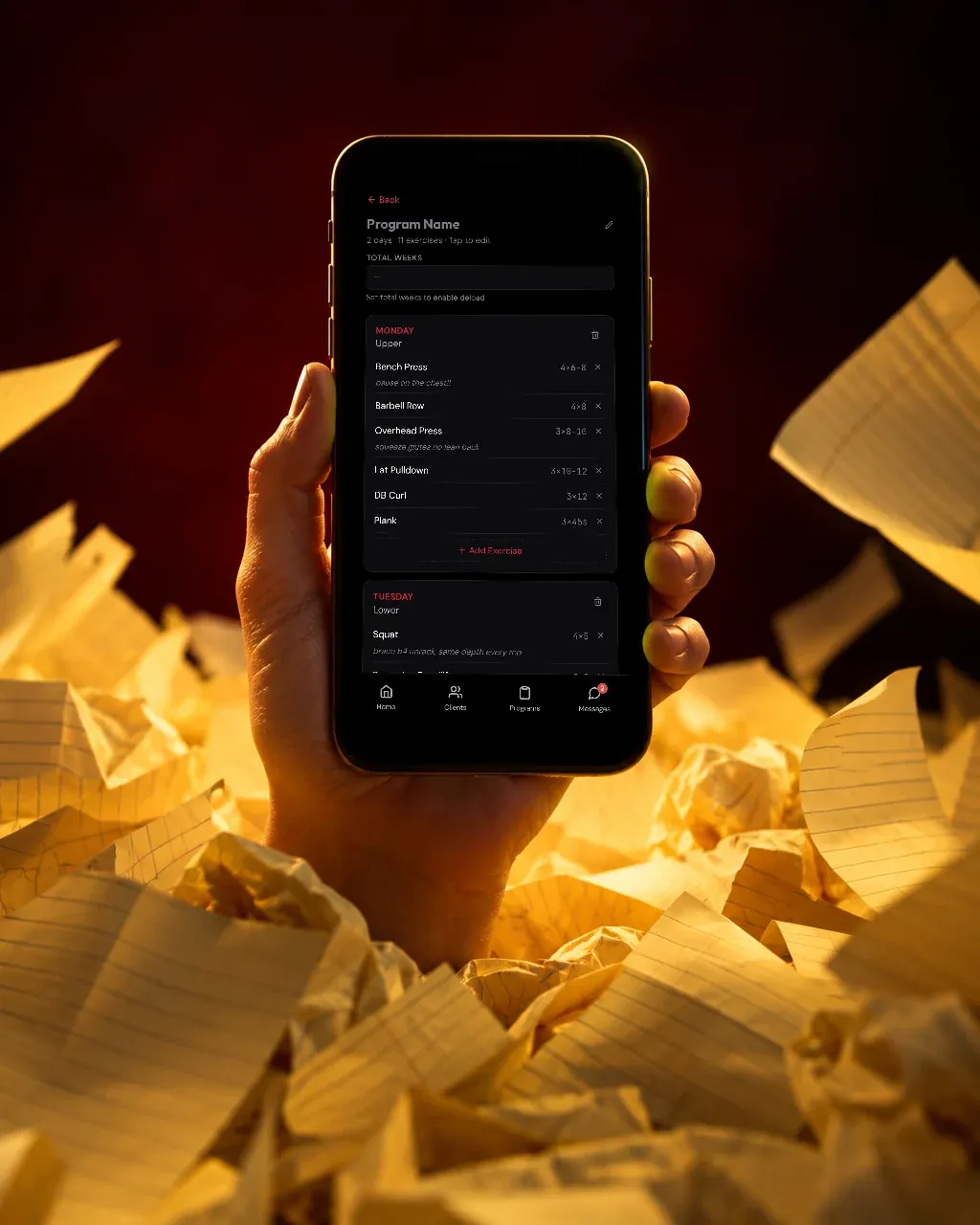
Your cue, on their screen.
The trainer's cue sits on the bench press, right above the sets the client is logging.
Try this in SyncSet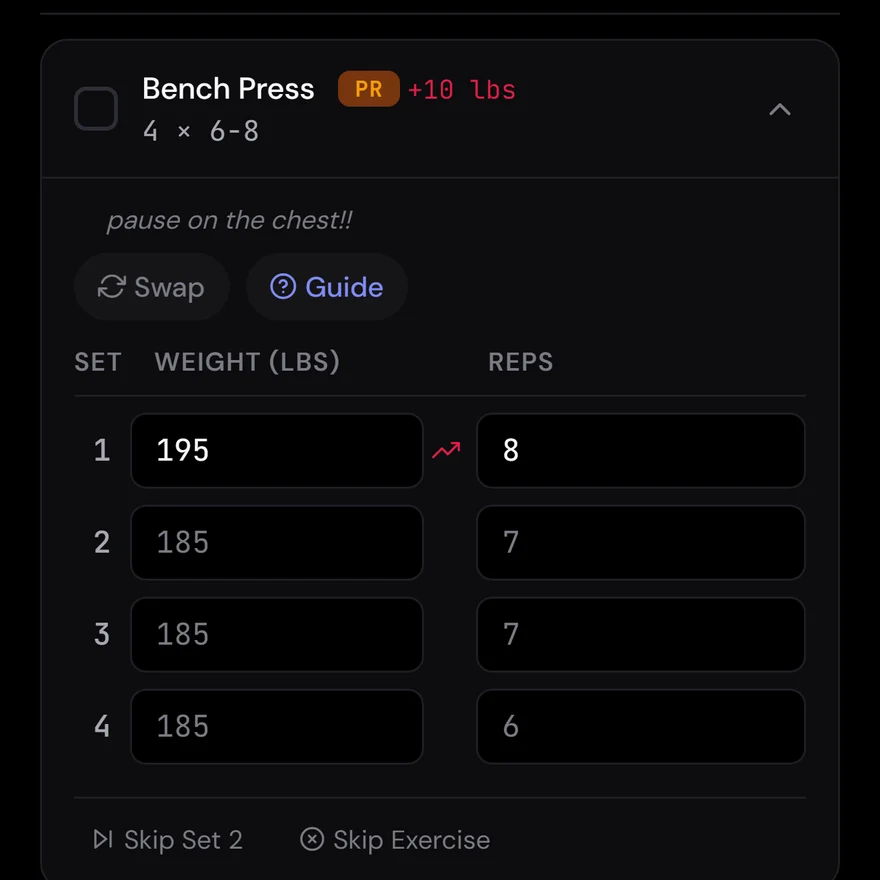
In SyncSet you write the cue on the same line as the exercise, the way you would text it: "Back squat 4x6, push the floor away." It stays on that exercise, and your client sees it above their sets when they open it.
Sources
All read on 2026-11-06.
- Chua L, Jimenez-Diaz J, Lewthwaite R, Kim T, Wulf G (2021). Superiority of external attentional focus for motor performance and learning: systematic reviews and meta-analyses. Psychological Bulletin, 147(6), 618 to 645. doi.org/10.1037/bul0000335
- Schoenfeld BJ, Vigotsky A, Contreras B, Golden S, Alto A, Larson R, Winkelman N, Paoli A (2018). Differential effects of attentional focus strategies during long-term resistance training. European Journal of Sport Science, 18(5), 705 to 712. doi.org/10.1080/17461391.2018.1447020
Keep going
-
 A 4-day upper/lower split for an intermediate client, with the research behind each choice
Read it, 7 minutes
-
 What SyncSet is (and what it is not)
Read it, 3 minutes
Paste a workout. Watch it transform.
Try it with one of your own programs. No account needed.