
Here is an eight-week program you can hand an intermediate client this week, with the research behind each choice in it. Use it as written, change it, or take the reasoning for the programs you already write. When a client asks why four sets and not six, or why they are not training to failure, the answers and their sources are below.
It also solves a problem the program cannot solve on its own. You send a good block by text, and by the fourth or fifth week it is buried under scheduling messages. Your client scrolls back through the thread to find leg day and picks today's weights from memory. The last section shows a way to send this program that keeps last week's numbers in front of them.
It is written for an intermediate client, which here means about six months of consistent lifting, the definition the American College of Sports Medicine used in its 2009 position stand. For someone newer, that stand suggested two to three days a week, so start them there instead.
The program
Four days a week for eight weeks. The same four days repeat, and what changes from week to week is the reps and the weight. There are no weights in it, because the load is your call, and warm-up sets are yours to add.
Upper lower split - 8 week block

Monday - Upper
Bench press 4x6-8, rest two minutes
Barbell row 4x6-8, rest ninety seconds
Overhead press 3x8-10, rest ninety seconds
Lat pulldown 3x10-12, rest ninety seconds
DB curls 3x10-12, rest one minute
Tricep pushdown 3x10-12, rest one minute

Tuesday - Lower
Back squat 4x6-8, rest two minutes
RDL 3x8-10, rest ninety seconds
Bulgarian split squat 3x8-10 each leg, rest ninety seconds
Leg curl 3x10-12, rest ninety seconds
Standing calf raise 3x12-15, rest one minute
Hanging knee raise or lying leg raise 3x10-12, rest one minute

Thursday - Upper
Incline DB press 4x8-10, rest two minutes
Seated cable row 4x8-10, rest ninety seconds
Cable fly 3x12-15, rest ninety seconds
Pull ups or lat pulldown 3x8-10, rest ninety seconds
Lateral raise 3x12-15, rest one minute
Hammer curls 3x10-12, rest one minute
Overhead tricep extension 3x10-12, rest one minute

Friday - Lower
Deadlift 3x4-6, rest three minutes
Leg press 3x10-12, rest ninety seconds
Hip thrust 3x8-10, rest ninety seconds
Leg extension 3x12-15, rest ninety seconds
Standing calf raise 3x12-15, rest one minute
Cable crunch 3x12-15, rest one minute
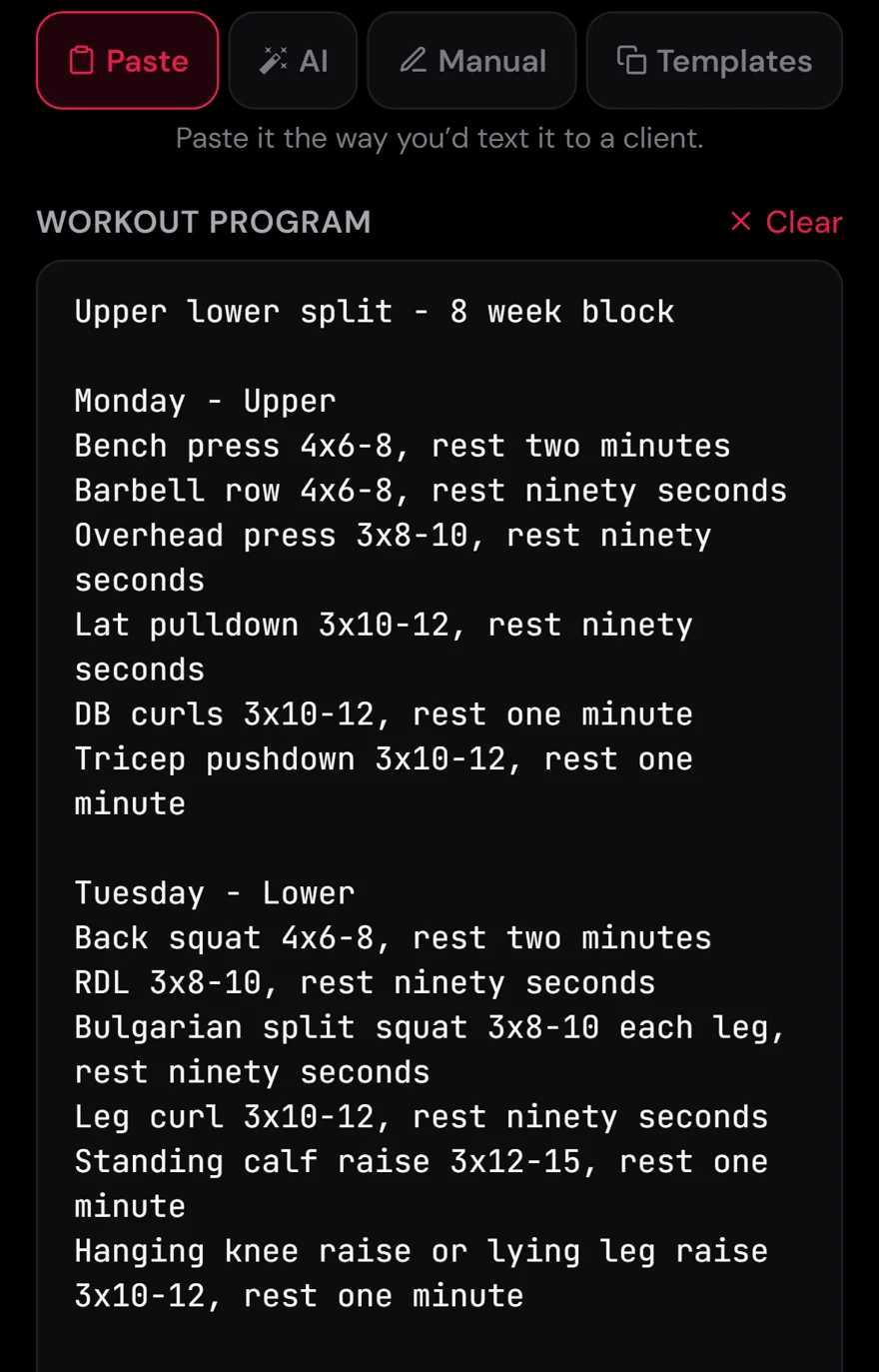
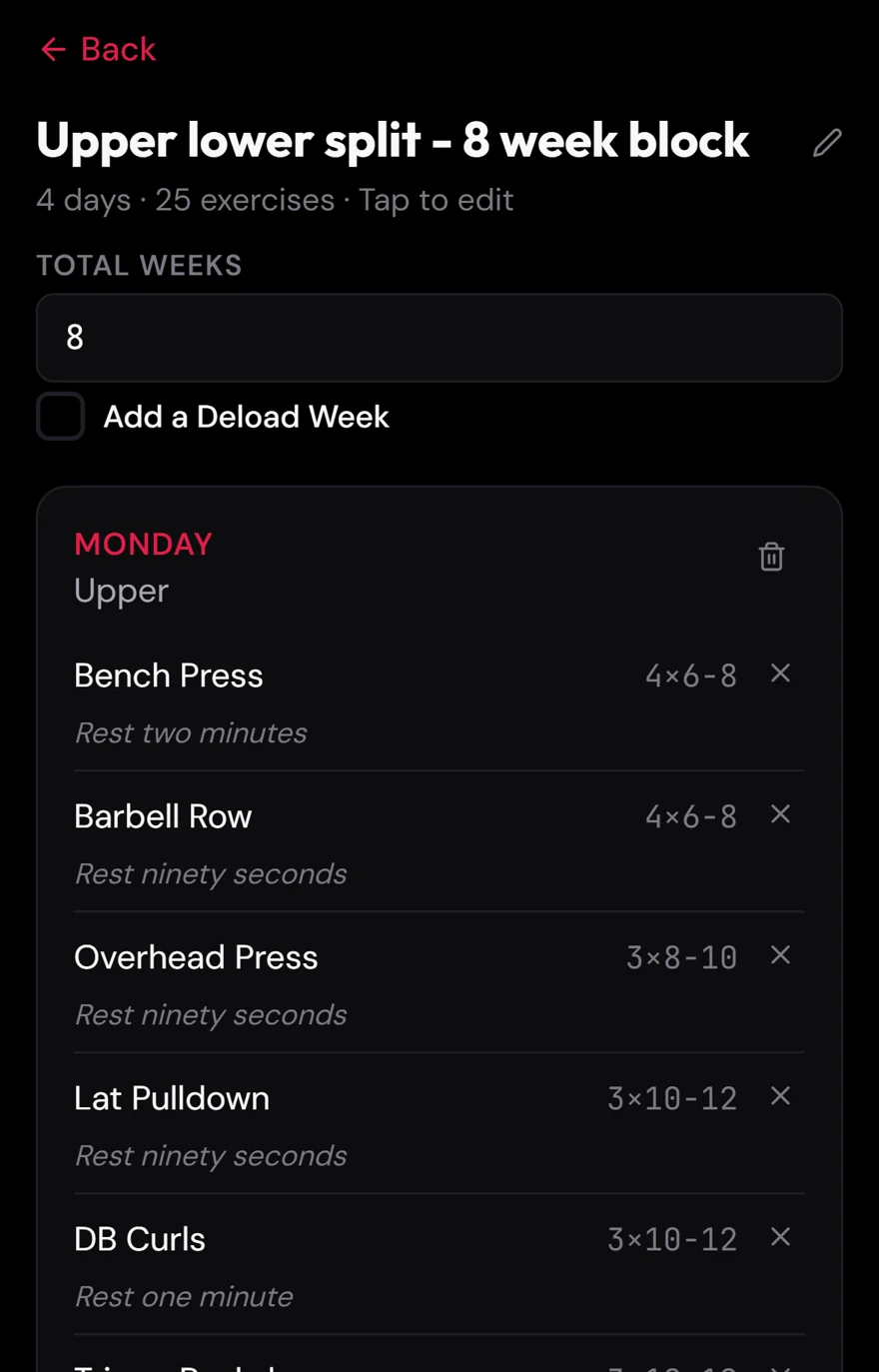
Copy it and paste it into the box on syncsetapp.com, under "Paste a workout". You do not need an account, and you will see the workout the way your client would.
Why four days
Each muscle group is trained twice a week, and four days is the easiest way to fit that in. When weekly sets were the same, a 2019 meta-analysis of 25 studies found that how many days a muscle was trained made no significant difference to growth. The College's 2026 position stand, which pooled 137 systematic reviews of healthy adults, agreed on growth and found strength did better with at least two sessions a week. If your client can only make three days, keep the weekly sets the same and spread them over three.
Why this many sets
Every major muscle group gets at least 10 sets a week. The 2026 stand found more growth at 10 or more weekly sets per muscle group, and one analysis it cites saw the extra growth level off past roughly 18 to 20. Counted directly, this program gives the chest 11 sets a week, the back 14, the quads 13, and the hamstrings and glutes 12 between them.
Shoulders, biceps and triceps each get 6 direct sets, which looks low until you count the pressing and rowing. A 2026 analysis of 67 studies compared ways of counting those sets, and the best match came from counting each pressing or pulling set as half a set for the smaller muscles it also works. Counted that way the shoulders get about 10 sets a week, the triceps about 11 and the biceps 13. Most people in those studies were young men (79 percent male, average age 25), so the numbers may not fit every client.
Why the heavy lift goes first
Each day opens with its heaviest lift for 4 to 10 reps. The lifts after it use 8 to 12, and the small ones at the end use 10 to 15. The 2026 stand found strength was helped by heavier loads and by doing a lift at the start of the session. For muscle growth the load matters less: a 2017 meta-analysis of 21 studies found similar growth from light and heavy loads when sets were taken to failure.
How hard to push
Tell your client to stop two or three reps short of failure. The program does not say this, so the cue is yours to give. A 2023 meta-analysis of 15 studies found no evidence that going to failure builds more muscle than stopping short, and the 2026 stand says failure is not needed for strength or growth.
How long to rest
Most lifts get ninety seconds. A 2024 meta-analysis of 9 studies suggested a small benefit for growth from resting longer than 60 seconds and could not detect more beyond 90, and its authors say the results varied a lot between studies. We chose the rest ourselves: two or three minutes on the first lift of the day, and one minute on the small lifts at the end so the session does not run long. None of these studies tested those choices.
How to progress over the eight weeks
Your client works inside the rep range. When they reach the top of it on every set, you raise the weight. We chose that rule ourselves; the 2009 stand used a similar one. An 8-week trial in 2022 had 43 trained lifters progress lower-body lifts either by adding weight or by adding reps, and both worked, with small differences between the groups.
Both ways depend on your client knowing last week's numbers. SyncSet remembers what your client did last week and shows it on each set, so they do not have to go back through their notes. SyncSet does not suggest weights. You still set them.
Sources
All read on 2026-10-05.
- Currier BS and colleagues (2026). American College of Sports Medicine Position Stand. Resistance Training Prescription for Muscle Function, Hypertrophy, and Physical Performance in Healthy Adults: An Overview of Reviews. Medicine and Science in Sports and Exercise, 58(4), 851 to 872. https://pubmed.ncbi.nlm.nih.gov/41843416/
- American College of Sports Medicine (2009). Position stand. Progression models in resistance training for healthy adults. Medicine and Science in Sports and Exercise, 41(3), 687 to 708. https://pubmed.ncbi.nlm.nih.gov/19204579/
- Schoenfeld BJ, Grgic J, Krieger J (2019). How many times per week should a muscle be trained to maximize muscle hypertrophy? Journal of Sports Sciences, 37(11), 1286 to 1295. https://pubmed.ncbi.nlm.nih.gov/30558493/
- Pelland JC, Remmert JF, Robinson ZP, Hinson SR, Zourdos MC (2026). The Resistance Training Dose Response: Meta-Regressions Exploring the Effects of Weekly Volume and Frequency on Muscle Hypertrophy and Strength Gains. Sports Medicine, 56(2), 481 to 505. https://pubmed.ncbi.nlm.nih.gov/41343037/
- Schoenfeld BJ, Grgic J, Ogborn D, Krieger JW (2017). Strength and Hypertrophy Adaptations Between Low- vs. High-Load Resistance Training. Journal of Strength and Conditioning Research, 31(12), 3508 to 3523. https://pubmed.ncbi.nlm.nih.gov/28834797/
- Refalo MC, Helms ER, Trexler ET, Hamilton DL, Fyfe JJ (2023). Influence of Resistance Training Proximity-to-Failure on Skeletal Muscle Hypertrophy. Sports Medicine, 53(3), 649 to 665. https://pubmed.ncbi.nlm.nih.gov/36334240/
- Singer A and colleagues (2024). Give it a rest: a systematic review with Bayesian meta-analysis on the effect of inter-set rest interval duration on muscle hypertrophy. Frontiers in Sports and Active Living, 6, 1429789. https://pubmed.ncbi.nlm.nih.gov/39205815/
- Plotkin D and colleagues (2022). Progressive overload without progressing load? The effects of load or repetition progression on muscular adaptations. PeerJ, 10, e14142. https://pubmed.ncbi.nlm.nih.gov/36199287/
Keep going
-
 How to write coaching cues your clients follow when you are not there
Read it, 4 minutes
-
 What SyncSet is (and what it is not)
Read it, 3 minutes
Paste a workout. Watch it transform.
Try it with one of your own programs. No account needed.