
Full-body workouts for a beginner client: a 3‑day program to copy
For a client who has never lifted, three full-body workouts a week train every main movement each week with a day to recover between sessions. Stop every set with 2 or 3 reps left in the tank, and add weight when every set reaches the top of its rep range.
Why full body, three days a week
The American College of Sports Medicine's 2009 position stand on resistance training recommends 2 to 3 days a week for a novice, meaning someone with no lifting experience or several years off. It also recommends loads the person could lift 8 to 12 times at most, and ordering each workout with big muscle groups before small ones and multi-joint exercises before single-joint ones.
Its 2026 update pooled 137 systematic reviews covering more than 30,000 healthy adults. Compared with no exercise, resistance training improved strength, muscle size, power and everyday physical function, and few program details changed those results much. Strength gains were larger with 2 to 3 sets and 2 or more sessions a week, and muscle growth was larger with higher weekly volume, 10 or more sets a week. The review concludes that healthy adults should do progressive resistance training.
The program below follows the 2009 points on frequency and order. Three workouts run on three separate days, each opens with a leg exercise before the smaller lifts, and every exercise gets 3 sets. The main lifts use 8 to 10 reps with 2 or 3 left in the tank, a load the client could lift about 10 to 13 times, in or near the 8 to 12 range.
Full body rather than a split is our choice, not a research finding. Every workout has a lower-body exercise, a push and a pull, so if the client misses one day, they still trained legs, pushing and pulling at least twice that week.
Weekly hard sets run from 3 for the hamstrings and the side of the shoulders to 9 for the back, all under the 10 sets a week the 2026 review linked with more growth. That is deliberate for the first month, while the client learns the movements. After 4 to 6 weeks, add a fourth set to the main lifts.
The program to copy
Full-body program for a beginner client
3 days a week, with a day off between (for example Monday, Wednesday, Friday)
Warm-up: 5 minutes. Rest: 60 to 90 seconds between sets.
Every set: stop with 2 or 3 reps left in the tank.
Add weight when every set of an exercise reaches the top of its range.

Workout 1 (squat, push, pull, core)
Goblet squat 3x8-10
Dumbbell bench press 3x8-10
Lat pulldown 3x8-10
Plank 3x30s

Workout 2 (legs, pull, press, core)
Leg press 3x10-12
Dumbbell row 3x8-10, each arm
Dumbbell shoulder press 3x8-10
Dead bug 3x10

Workout 3 (hinge, push, pull, shoulders)
Dumbbell Romanian deadlift 3x8-10
Push-up 3x5-12 (hands on a bench until 5 on the floor is possible)
Seated cable row 3x10-12
Lateral raise 3x12-15
Each exercise has a rep range, so the reps tell you when to go up. The lateral raise uses 12 to 15 because the jump between dumbbells is large for a small lift, and the extra reps leave room to build before the next one (the rep range rule covers why).
The machines can be swapped for what your gym has. The pattern matters more than the exact exercise: a squat, a hinge, a push, a pull and some core work across the week.
How hard each set should be
One standard for every set: stop when the client could do 2 or 3 more reps with the same form. For the first workout, pick a weight they could lift about 12 times at most. If they reach the top of the range with plenty clearly left, go up on the next set.
Stopping short of failure costs little. The 2026 review found that training to momentary failure did not consistently change results.
Expect a new client to misjudge it. A 2022 review of 12 studies with 414 healthy people found that, on average, people guessed about one rep fewer left than they really had, with wide variation between studies. Training experience did not seem to change accuracy. Guesses were more accurate closer to failure, with heavier loads and in later sets. The authors concluded that people are imperfect at predicting how close they are to failure, whatever their training background.
That is why the rep count decides when to add weight, and reps left only guides the effort. Teach it in the first week: after each exercise, ask "Could you have done 2 or 3 more just like those?" and watch the last rep. If it moved as fast as the first, there were more left.
When to add weight
The rule for this program: when every set of an exercise reaches the top of its range with good form, add weight next session and start again at the bottom of the range.
- Lower-body lifts (goblet squat, leg press, Romanian deadlift): about 5 lb.
- Upper-body lifts: the smallest step you have, 2.5 lb if your gym has it.
- When the next dumbbell is too big a jump, stay at the top of the range for another week or two before moving up.
- Push-ups: start with hands on a bench. When every set reaches 12, use a lower surface, until the floor works.
The 2009 position stand suggests raising the load by 2 to 10% once someone can do one to two reps over the target. Reaching the top of an 8 to 10 range is two reps over the bottom, the same signal. The full method, with stalls and drops, is in the rep range rule.
Fitting it to your client
Ways to adjust it:
- Two days a week: alternate the three workouts in order. Two days is inside the position stand's 2 to 3.
- No leg press: repeat the goblet squat, or use a split squat holding dumbbells.
- No cable machine: a dumbbell row for the seated row, and a band-assisted pull-down or an assisted pull-up machine for the lat pulldown.
- Pain during a movement: change the exercise, and keep it changed until you know why.
- Any three days work, as long as there is a day off between them.
How SyncSet handles it
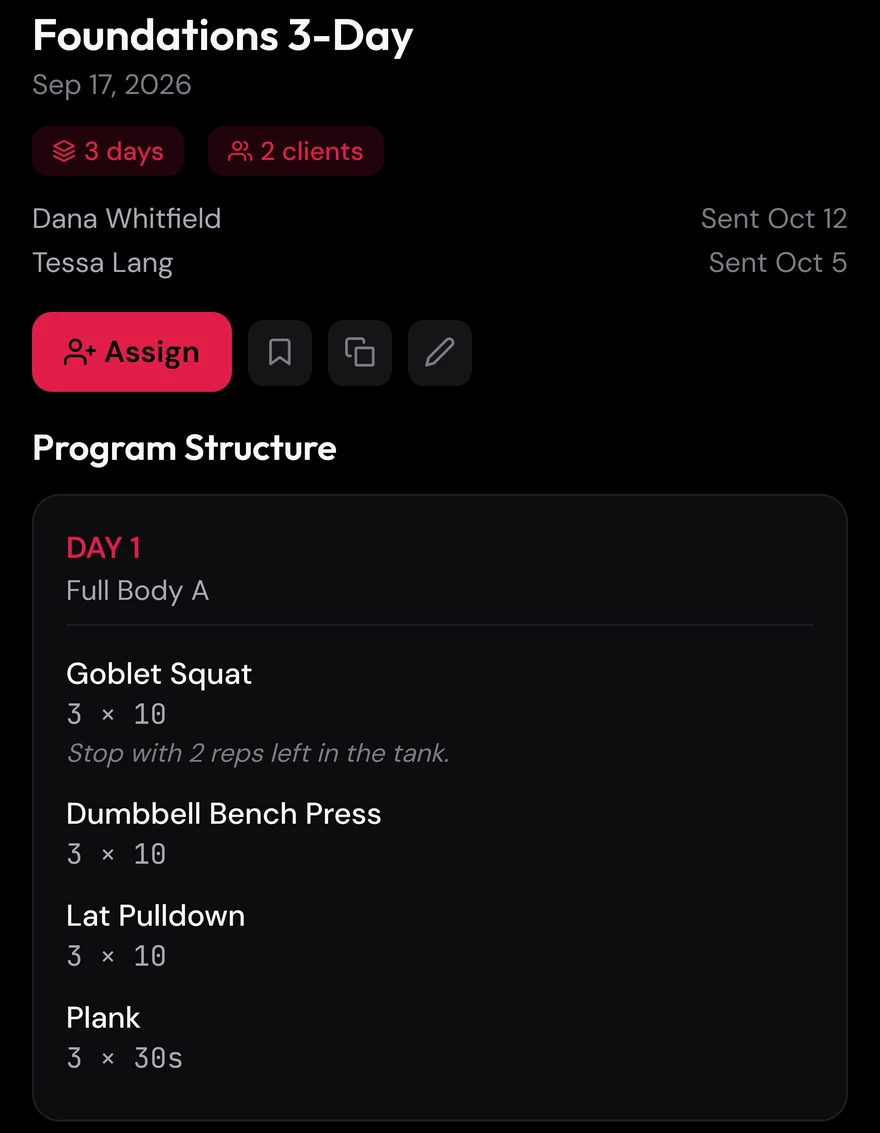
Paste the program the way you would write it, such as "Goblet squat 3x10", and SyncSet turns it into workouts you can assign. Notes stay with each exercise, like the one on the goblet squat below. Your client sees each exercise with its sets and reps, and your note when they open it. While they log, every set shows the weight and reps from last time, so going up is easy to spot.
Questions trainers ask
How many days a week should a beginner lift weights?
Two to three days a week, according to the American College of Sports Medicine's 2009 position stand. This program uses three full-body workouts with a day off between each.
Is full body or a split better for a beginner client?
Either can work. With 2 or 3 training days, full body is our choice, because every muscle is trained on each workout day and a missed workout costs less.
How many sets and reps should a beginner do?
The 2009 position stand recommends loads a novice could lift 8 to 12 times at most, and the 2026 update linked 2 to 3 sets with larger strength gains. This program uses 3 sets of 8 to 10 reps on the main lifts and up to 15 on a few smaller ones, stopping each set with 2 or 3 reps left.
How long should a beginner rest between sets?
This program uses 60 to 90 seconds. The 2009 position stand suggests 1 to 2 minutes for training aimed at muscle size, so if a client needs longer to keep their form, give it.
When should a beginner increase weight?
When every set of an exercise reaches the top of its rep range with good form. Add about 5 lb on lower-body lifts and the smallest step available on upper-body lifts, and start again at the bottom of the range.
Sources
All read on 2026-11-11.
- American College of Sports Medicine (2009). Progression models in resistance training for healthy adults. Medicine and Science in Sports and Exercise, 41(3), 687 to 708. doi.org/10.1249/MSS.0b013e3181915670
- Currier BS, D'Souza AC, Singh MAF, and colleagues (2026). American College of Sports Medicine position stand. Resistance training prescription for muscle function, hypertrophy, and physical performance in healthy adults: an overview of reviews. Medicine and Science in Sports and Exercise, 58(4), 851 to 872. doi.org/10.1249/MSS.0000000000003897
- Halperin I, Malleron T, Har-Nir I, Androulakis-Korakakis P, Wolf M, Fisher J, Steele J (2022). Accuracy in predicting repetitions to task failure in resistance exercise: a scoping review and exploratory meta-analysis. Sports Medicine, 52(2), 377 to 390. doi.org/10.1007/s40279-021-01559-x
Keep going
-
 When to add weight: the rep range rule
Read it, 5 minutes
-
 A 4-day upper/lower split for an intermediate client, with the research behind each choice
Read it, 7 minutes
Paste a workout. Watch it transform.
Try it with one of your own programs. No account needed.