
Client not showing up? What to send, and how to keep them
Clients rarely say they are quitting. They miss a session, answer a little slower, then stop. A short text that names a day, sent in the first week of silence, gives them an easy way back.
When clients drop off
A 2016 study followed the records of 5,240 members of a gym in Rio de Janeiro for up to a year each. 63% of new members stopped before their third month. Fewer than 4% were still training after 12 months (Sperandei and colleagues, Journal of Science and Medicine in Sport).
Those were gym members training on their own, and the study counted cancelled memberships. It can't tell you how long clients with a trainer stay. It does show when people new to training are most likely to stop: the first three months.
Treat a new client's first three months as the time to watch closely, and reach out early when they go quiet, before the silence gets long.
The early signs
These come from coaching practice, not from a study. None means much alone. Two together, or one that lasts a week, is worth a message:
- A missed session, or a week with no training logged.
- Check-ins sent late, or not at all. (A weekly check-in shows these sooner.)
- Replies getting shorter, or read and not answered.
- Workouts cut short, or weights going down.
- A cancelled session with no new day offered.
Texts to send, and when
When a client misses a session or goes a week without training

hey, haven't seen you this week. all good? want to train thursday? we can keep it short

No reply after 3 days

no stress if this week's a mess. same time next tuesday?

When they reply that life is crazy

totally get it. let's do 2 shorter days a week for the next 2 weeks. which 2 work?

Gone for 2 or 3 weeks

hey, been thinking about your program. want to restart with 2 short workouts a week for a bit? i can do monday or wednesday

Still nothing a week later (the last one)

no pressure at all. whenever you want to start again, just text me and we'll pick a day

For an online client who stopped logging

hey, saw this week's workouts didn't get logged. all good? want to just do monday's workout this week and go from there?
Each one is short and gives a specific next step: a day, a choice of two, or one workout. The client only has to say yes. After the last one, stop chasing. It leaves the door open without another reminder of what they missed.
There is research behind naming the day. A 2006 review of 94 tests found that people who planned when, where and how they would act reached their goals more often than people who only intended to (Gollwitzer and Sheeran). A 2022 review of 41 trials with 5,439 people found the same for exercise: helping people plan when, where and how they would be active, and how to handle what gets in the way, raised physical activity by a small to moderate amount. It worked better face to face, and when the plan was followed up (Peng and colleagues).
Neither review tested a text from a trainer. Our reading is that a message with a day on it does the planning for the client. "Let me know when you're free" leaves it all to them.
What to skip:
- "Where have you been?" It asks them to explain, and silence is easier.
- The long paragraph about their goals. It reads as a lecture.
- A list of the workouts they missed. Nobody wants homework to come back to.
Make coming back easy
A client who went quiet is coming back to the same program that got away from them. Make the next two weeks smaller:
- Fewer days. Two a week instead of four.
- Shorter workouts. The main lifts and one or two others, about 30 minutes.
- Pick up from where they are, not where the plan says they should be. No making up missed workouts.
After two weeks of showing up, add a day back. Tell them that is the plan from the start, so the smaller version feels like a step, not a demotion.
How SyncSet handles it
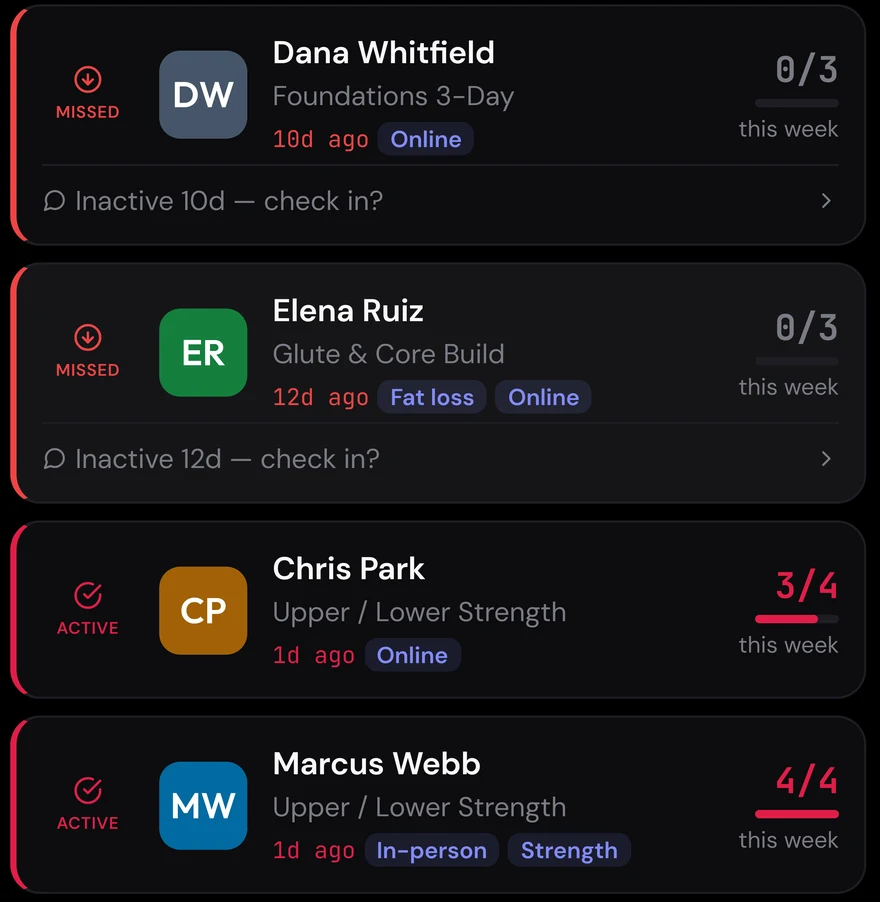
On your client list, a client with no activity for 7 days or more is marked Missed, with a line such as "Inactive 10d — check in?" that opens a message to them. Your home screen keeps an At Risk list with one reason beside each client, such as "2 of 4 recent sessions done", "Hasn't opened the app recently" or "Hasn't read your messages". A morning notification tells you who has not logged in for 7 days or more.
On your client's side, a scheduled training day with nothing logged by midday brings a reminder, and so does a workout they started and left unfinished for two hours. Both are on by default, and clients can switch them off.
Questions trainers ask
How long do new clients usually stay?
There is no good public figure for personal training clients. One large study of 5,240 gym members, who trained without a trainer, found 63% cancelled before their third month. The first three months are when to watch closely.
What should I text a client who stopped showing up?
Something short that offers a specific day and makes it easy to say yes. For example: "hey, haven't seen you this week. all good? want to train thursday? we can keep it short". Leave out "where have you been?" and anything about what they missed.
How long should I wait before following up?
Our habit, not a research finding: about three days. Then one more short message that takes the pressure off and names a new day, such as "no stress if this week's a mess. same time next tuesday?"
Should I charge for no-shows?
That is your policy to set. Whatever you choose, put it in writing when a client starts, so a missed session is a rule you both agreed to and not an argument. The texts above work either way.
Should I ask why they stopped?
Not in the first message. A question about why asks them to explain themselves, and silence is easier. Once they reply, ask what would make training easier for the next two weeks, and change the plan to fit.
Sources
All read on 2026-11-11.
- Sperandei S, Vieira MC, Reis AC (2016). Adherence to physical activity in an unsupervised setting: explanatory variables for high attrition rates among fitness center members. Journal of Science and Medicine in Sport, 19(11), 916 to 920. doi.org/10.1016/j.jsams.2015.12.522
- Gollwitzer PM, Sheeran P (2006). Implementation intentions and goal achievement: a meta-analysis of effects and processes. Advances in Experimental Social Psychology, 38, 69 to 119. doi.org/10.1016/S0065-2601(06)38002-1
- Peng S, Othman AT, Yuan F, Liang J (2022). The effectiveness of planning interventions for improving physical activity in the general population: a systematic review and meta-analysis of randomized controlled trials. International Journal of Environmental Research and Public Health, 19(12), 7337. doi.org/10.3390/ijerph19127337
Keep going


Paste a workout. Watch it transform.
Try it with one of your own programs. No account needed.